
Home / Key facts & sources
Key facts and sources
Every number on this site, where it comes from and when it was true. Medical statements are backed by the sources listed below.
Information confirmed by Min Clinic · Last updated 25 November 2026
| Fact | Value | Source | As of |
|---|---|---|---|
| miraDry at Min Clinic since | 2018 | Min Clinic | 2026 |
| #1 miraDry clinic in Korea by treatment volume | 2019, 2020, 2021 (3 consecutive years) | Plaques from miraDry, Inc. / Sientra, Inc.; Medisobi News, 27 Feb 2026 | 2021 |
| Cumulative miraDry Fresh treatments | 2,000 (as of January 2026, plaque from miraDry headquarters) | Medisobi News, 27 Feb 2026 | Jan 2026 |
| Cumulative miraDry treatments (latest) | 2,300+ | Min Clinic records | 2026 |
| Genuine miraDry tip usage among the top in Korea | 7 consecutive years (2019–2025) | Min Clinic miraDry page | 2025 |
| English-speaking patients treated with miraDry | 50+ | Min Clinic records | 2026 |
| Official miraDry certified center | Yes | Min Clinic; miraDry plaques | 2026 |
| Google rating | 4.9 from 431 reviews (49 mention miraDry) | Google Maps | November 25, 2026 |
| Price, both underarms | KRW 1,900,000 – 2,500,000, VAT separate, same for all patients | Min Clinic | Nov 2026 |
| Included | Local anesthesia; An individually designed treatment plan; Treatment performed by the doctor; Post-treatment care and aftercare amenities; A certificate of authenticity, including a 1-year assurance from your treatment date | Min Clinic | Nov 2026 |
| Treatment time | About 60 minutes (consultation 15–30 minutes) | Min Clinic | Nov 2026 |
| Doctor | A doctor is on site whenever the clinic is open and performs every treatment | Min Clinic | Nov 2026 |
| Follow-up | Recovery check by KakaoTalk or WhatsApp | Min Clinic | Nov 2026 |
| Opening hours | Mon–Thu 10:00–19:00, Fri 10:00–20:00, Sat 10:00–15:00, lunch 13:00–14:00; closed Sundays and public holidays | min-clinic.co.kr | Nov 2026 |
| Address | 4F, Daedong Tower, 326 Dosan-daero, Gangnam-gu, Seoul | Google Maps | Nov 2026 |
| Foreign-patient registration | M-2020-01-08-5734 | Min Clinic | 2026 |
| Doctors visiting to learn miraDry Fresh | Clinical training for doctors from Kazakhstan | K Spirit, 25 Jun 2026 | Jun 2026 |
Medical and regulatory sources
Independent sources for what miraDry is, how it works and what results studies report.
- K103014 — miraDry System (Miramar Labs) — US FDA 510(k) database, 2011. First FDA clearance (28 Jan 2011) for the treatment of primary axillary hyperhidrosis.
- K150419 — miraDry System MD4000 (Miramar Labs) — US FDA 510(k) database, 2015. Clearance (19 Jun 2015) extended to underarm hair reduction for Fitzpatrick skin types I–IV, alongside axillary hyperhidrosis.
- K180396 — miraDry System (Miramar Labs) — US FDA 510(k) database, 2018. Clearance (15 Mar 2018) adds that, when used to treat primary axillary hyperhidrosis, miraDry may reduce underarm odor.
- miraDry® — International Hyperhidrosis Society. Patient guide: FDA-cleared in 2011, works by heating the layer where sweat glands sit; reports sweat reduction in over 90% of patients in the cited data.
- Sweaty armpits (axillary hyperhidrosis) — International Hyperhidrosis Society. Overview of underarm sweating treatments, from antiperspirants and Botox to miraDry and surgery.
- OnabotulinumtoxinA injections (Botox®) — International Hyperhidrosis Society. Botox reduces underarm sweating by about 82–87%; dryness usually lasts 4–12 months, so injections are repeated.
- Hyperhidrosis: diagnosis and treatment — American Academy of Dermatology. Lists microwave thermolysis of the underarms as an in-office dermatologic procedure that destroys sweat glands with heat; botulinum toxin is temporary.
- Excessive sweating (hyperhidrosis) — NHS (UK), 2023. UK guidance on hyperhidrosis and its treatments, from antiperspirants to Botox and sweat-gland surgery.
- Hyperhidrosis (excessive sweating) — DermNet. Lists microwave thermolysis (miraDry, FDA-approved 2011) among the ways to remove axillary sweat glands.
- Bromhidrosis — DermNet. Underarm odor usually comes from apocrine sweat broken down by skin bacteria; microwave treatment is among the options. ICD-10 L75.0.
- Glaser DA et al. A randomized, blinded clinical evaluation of a novel microwave device for treating axillary hyperhidrosis — Dermatologic Surgery, 2012. Sham-controlled trial: 89% responders at 30 days vs 54% with sham; 69% still responding at 12 months.
- Hong HC et al. Clinical evaluation of a microwave device for treating axillary hyperhidrosis — Dermatologic Surgery, 2012. 31 adults followed 12 months: 90.3% had at least a 50% reduction in measured sweat.
- Lupin M et al. Long-term efficacy and quality of life assessment for treatment of axillary hyperhidrosis with a microwave device — Dermatologic Surgery, 2014. Long-term follow-up and quality-of-life report on microwave treatment of axillary hyperhidrosis.
- Lee SJ et al. The efficacy of a microwave device for treating axillary hyperhidrosis and osmidrosis in Asians (Seoul) — Journal of Cosmetic and Laser Therapy, 2013. Korean patients followed 7 months: 83.3% of sweaty underarms improved by 2+ severity points; 93.8% of underarms with odor had good to excellent results.
- Zhang Y et al. Clinical efficacy of microwave in the treatment of axillary osmidrosis and primary hyperhidrosis — Dermatologic Therapy, 2022. Patients followed 2 years: sweat and odor improved significantly, and biopsies showed fewer apocrine glands.
- Grove GL et al. Botulinum toxin A versus microwave thermolysis for primary axillary hyperhidrosis: a randomized controlled trial — JAAD International, 2024. One underarm Botox, the other microwave: equal sweat reduction at 1 year, but only the microwave side kept odor reduction and showed hair reduction; 76% preferred microwave.
- Hsu TH et al. A systematic review of microwave-based therapy for axillary hyperhidrosis — Journal of Cosmetic and Laser Therapy, 2017. Review of 5 trials (189 patients): long-term efficacy with mostly mild side effects; the authors call for larger studies.
- Brauer JA et al. A prospective study of axillary hair reduction in patients treated with microwave technology — Dermatologic Surgery, 2017. 56 people followed 12 months: about 70% average underarm hair reduction, for light and dark hair.
- Registration system for medical institutions attracting foreign patients — Medical Korea (KHIDI). Korea's official registration system for clinics serving foreign patients; registered institutions must carry malpractice liability insurance.
- Registered hospitals (lookup) — Medical Korea (KHIDI). Official search of institutions registered to attract foreign patients.
- L74.510 — Primary focal hyperhidrosis, axilla — ICD10Data (ICD-10-CM). Diagnosis code for the condition miraDry is cleared for.
- L75.0 — Bromhidrosis — ICD10Data (ICD-10-CM). Diagnosis code for underarm odor (bromhidrosis / osmidrosis).
Plaque photos: What is miraDry. Press: Why Min Clinic. Reviews: Results.
Keep exploring
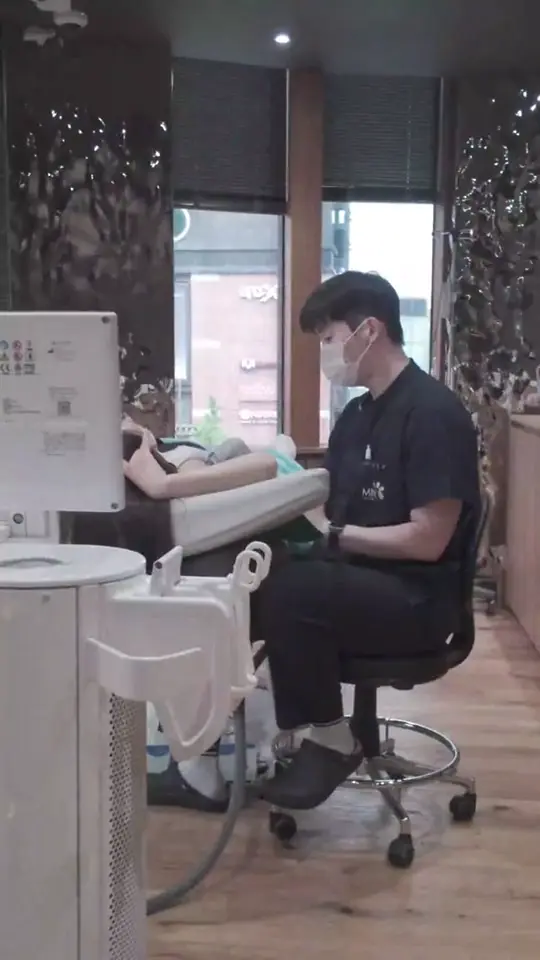 Min Clinic · Gangnam, Seoul
 Min Clinic · Gangnam, Seoul
 Min Clinic · Gangnam, Seoul
 Min Clinic · Gangnam, Seoul
Ready to ask?
Visit us
Min Clinic
4F, Daedong Tower, 326 Dosan-daero, Gangnam-gu, Seoul
Apgujeong Rodeo Station (Suin-Bundang Line), Exit 5: about 5 minutes on foot
| Monday – Thursday | 10:00 – 19:00 |
|---|---|
| Friday | 10:00 – 20:00 |
| Saturday | 10:00 – 15:00 |
| Lunch break (weekdays) | 13:00 – 14:00 |
| Sunday & public holidays | Closed |
Ask us about miraDry
Tell us your concern and travel dates. Our English-speaking staff reply on WhatsApp during clinic hours.
- Free to ask
- No obligation
- English-speaking staff